I move through paintings sometimes. I like the way it feels to be amongst the oils. I love Turner’s light and Rembrandt’s shadows. I once got lost in Nash’s The Menin Road. The Lady of Shalott(*) took me to places sorrowful.
So many other journeys. I often get stuck on gallery floors, rooted in a stream of glimpsers, gazing. The Mathematician too. We’ve had curators come to us and talk about the works. They’ve shown us things I know we would have missed.
I move as if through paintings sometimes. When the light outside is too beautiful to believe, the leaves too real, the colours too bold. When life’s sublime (as the Romantics used the term). All for no cost save the effort to go out.
We go out, The Mathematician and I, along a favourite route. It’s colder than the week before and thick with snow. There’s not a cloud in the sky.
“The river must still be frozen, right?” I say, as we crunch along.
“For sure. It was -12 last night, and hasn’t gone above zero for weeks.”
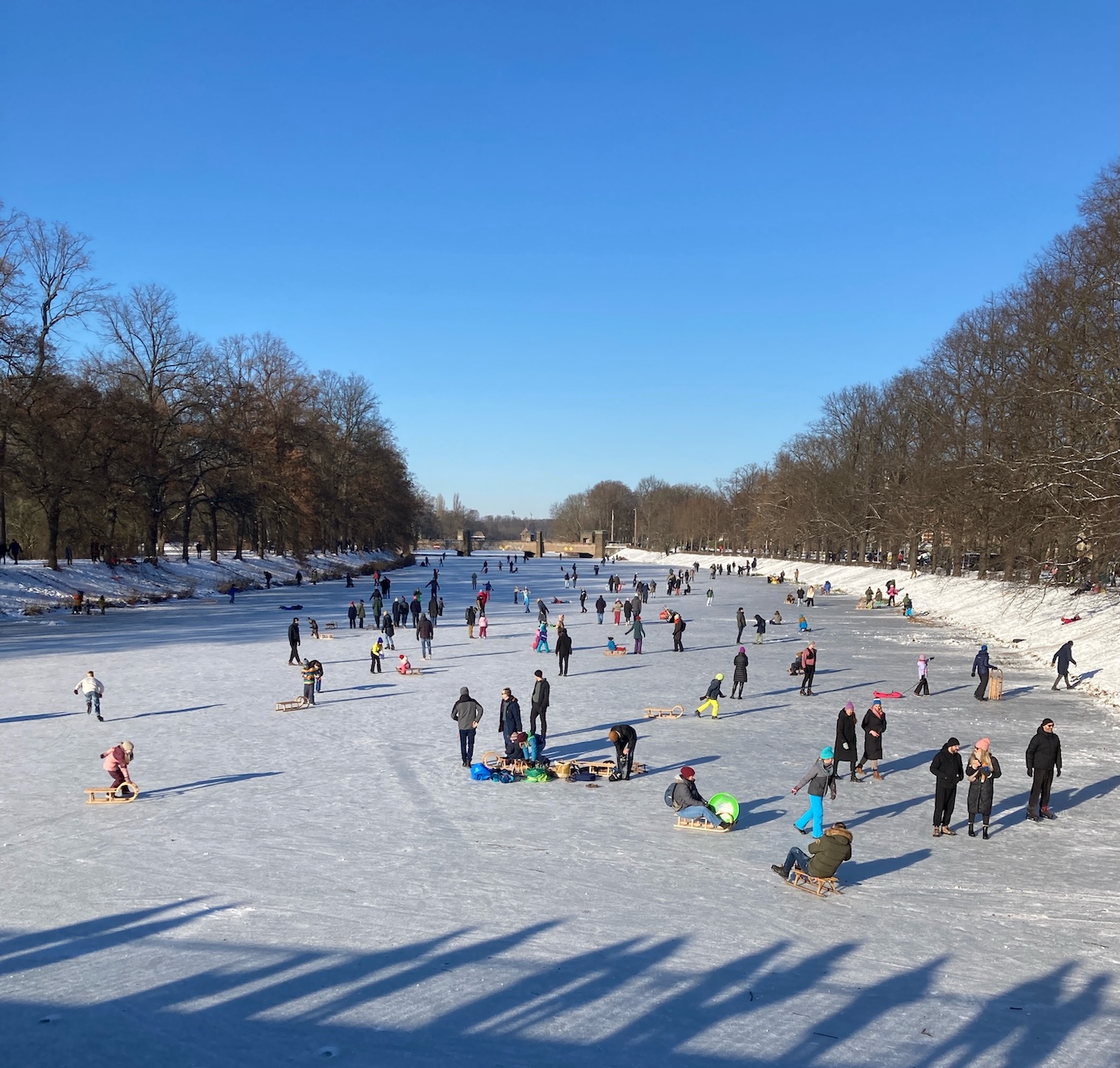
It absolutely is, and thickly so. It’s amazing to see — solid ice from bank to bank. It’s alive with buzz and bustle. Many folk are out on it. There are families with small children, whose colourful coats are a flurry as they run and slide and laugh. Some people have brought ice skates and are weaving up and down the river, unrestrained by any barriers. Three young women in white figure skates perform more elegant moves. Farther north, by the canoe wharf, several guys have made a makeshift ice hockey rink. The satisfying clack of the puck blends with a chorus of enjoyment.
The more enterprising kids have taken their sledges north of the Saxony Bridge where the banks are steeper. They launch themselves down to the cheers of their parents and race out across the ice, some nearly reaching the bank on the other side.
We join the merry folk. How often can you say you’ve walked up a river? Surprisingly, it’s less slippery than the snowy path. (The path immediately beside the river, at the bottom of the bank, is regularly traversed by cross-country skiers.) We pass a few boys with sticks hammering the ice. We’d seen this a week before, on the nearby lake.
“You have to question their self-preservation instinct,” I say.
“They do know what’ll happen if they break the ice right beneath their feet, I assume.”
We err on the side of idiocy, and give them a wide berth.
“How many people do you think can walk here before it begins to crack?” I ask.
“Oh, a lot, I think. The water’s frozen pretty thick. I mean, it couldn’t take the city, but a few hundred? No problem.”
“I’m surprised how many came out. It’s such a festive atmosphere! They just need a Glühwein stand nearby.”
We both struggle to leave the place, despite a growing hunger. It’s just so perfect. Warm sun on the face, cold ice underfoot. We even spot a buzzard circling overhead, great wings tipped with gold. Pure art.
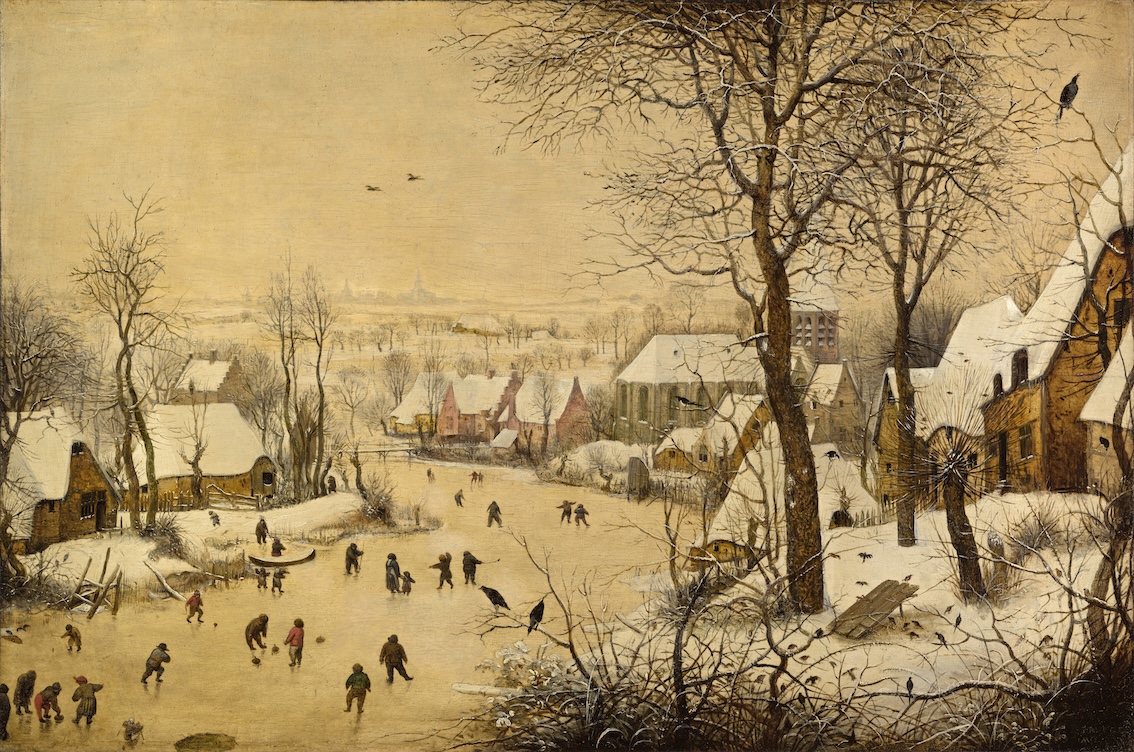
“Today it really looks like a Bruegel painting,” says The Mathematician. “Like the Winter Landscape picture. There are even people curling!”
We both laugh for the joy of it.
Walking back through Clara Zetkin park is like crossing a giant crème brûlée: a layer of ice has formed over the snow that makes a satisfying crunch as we step on it and sink beneath.
Back on the streets, the going’s slow, despite the gritted pavements. But we don’t care. This is a landscape we’re in no hurry to leave.
—
(*) By John William Waterhouse