The city’s full of story and my own demands attention.
The Mathematician’s excited. She’s received the latest newsletter from the Leipzig City website and there’s a sale on.
“It’s actor’s clothes,” she says. “Shauspiel Leipzig are selling off a lot of old costumes. We have to go! Maybe they’ve got a nice hat for me or something you could wear when you’re GMing. I can’t wait to see what they have!”
“When?”
“This Saturday.”
“Okay,” I nod. “We could always head out after coffee, walk along the river, cut through the music quarter ….”
“Yes! A little adventure.”
“Gao’s nearby. We could grab lunch there.”
She smiles. It’s only Wednesday but I can see her counting down the hours.
The next days bring two things: a deepening cold and an easterly wind. The temperature’s fine — we’ve hats and gloves and trams if needed — but the wind’s carrying over smoke from a legion of Eastern European chimneys. (To add to the coal- and wood-burning activities of the Germans.) The local air quality monitors show numbers topping 150. (Unhealthy for everyone. The EU safe limit is 50.) Come Friday, the city council is issuing warnings to stay indoors.
But the look on my sweet Mathematician’s face …. I keep my fingers crossed that the wind will shift direction.
When Saturday comes, I realise I’ve made the wrong gesture. The Germans squeeze their thumbs for luck, they don’t cross their fingers. The AQI’s still high.
“What about this,” I say, as we sit by the window and drink our coffee. “We have a relaxed morning — read a bit, crochet a bit — then walk to Ouai for lunch (or tram it if things don’t improve). From there, we’ll walk into town to the theatre and see what nice things they have. Sound good?”
“Sounds good. I know a nice way we can go, along the backstreets. And I don’t think it’ll be very busy at the Shauspiel — it’s freezing outside.”
“Alright then.”
The air quality dips below 100. A sign! We walk to the restaurant. The smell’s not great outside, and it’s hard to tell if it’s cloudy or smoggy, but we’ve been cooped up indoors for the last few days and want to purge the cabin fever.
We eat a good meal, pay, and put on our coats.
“Hm,” I say.
The Mathematician sees me looking at my phone.
“Is it bad?” she asks.
“Yeah, kinda. That little drop before was an anomaly. It’s back up above 100.” I look out the window at the people walking past. “Why don’t we just risk it. I fancy the walk, and we can just hold our breath.” I grin.
She nods. “I’m up for it.”
We cross into Beethoven past the impressive Federal Administrative Court and skirt the building’s many lion heads.
“They leave messages in the ones with open mouths,” I say.
“Who?”
“The old 19th century gangs. Can’t be surveilled by modern investigators — nothing digital to hack. Unless they find the notes, of course.”
“Something you’re working on?”
“Hm … no. Kind of. I mean look at these buildings! They’re just screaming ideas.”
I skip along to the next street and stash my fingers and smiles — don’t want to be looking like a Person of Interest walking past the guards at the U.S. Consulate General. We cross into Friedrich-Ebert, turn off into the park by the sculpture of a trilobite, and head into the backstreets of Reichel and Elster.
“That’s a lot of pebble-dash,” I say, looking at the prefab tower blocks.
“Affordable housing’s important though.”
“True, true. But does cheap have to mean ugly? Seriously, who thought pressing pebbles into concrete would make residents smile? It’s like a drunkard’s braille diary. But, it is nice to explore a new street,” I concede. “Thought we’d walked the whole of Leipzig.”
“Apparently not. But we have been here.”
We enter Dorotheenplatz, a peculiar parallelogram of grass divided by paths and surrounded by 80s-style buildings with russet tile façades. I laugh.
“They look like bathroom tiles.”
“Well, you were moaning about the pebble-dash.”
“There’s still pebble dash. Look at the lintels over the windows.”
I can’t get the thought of toilet freshener from my mind. The place is fascinating, though. The ground floors of all the buildings are given over to shops, restaurants, bakers, and hair dressers. It was built with community in mind, and maybe, for the locals, it still offers it.
We turn off into Zentral and take a path across a small green towards Nikischplatz. We pass a large stack of discarded Christmas trees(*). The Mathematician stops me and points.
“Look at these buildings ahead. It’s like a giant’s stepped in and pulled them apart with her hands.”
She’s right. It looks as if they’ve been opened like some hinged Edwardian apothecary cabinet. We stand and admire the spectacle, then continue up the path.
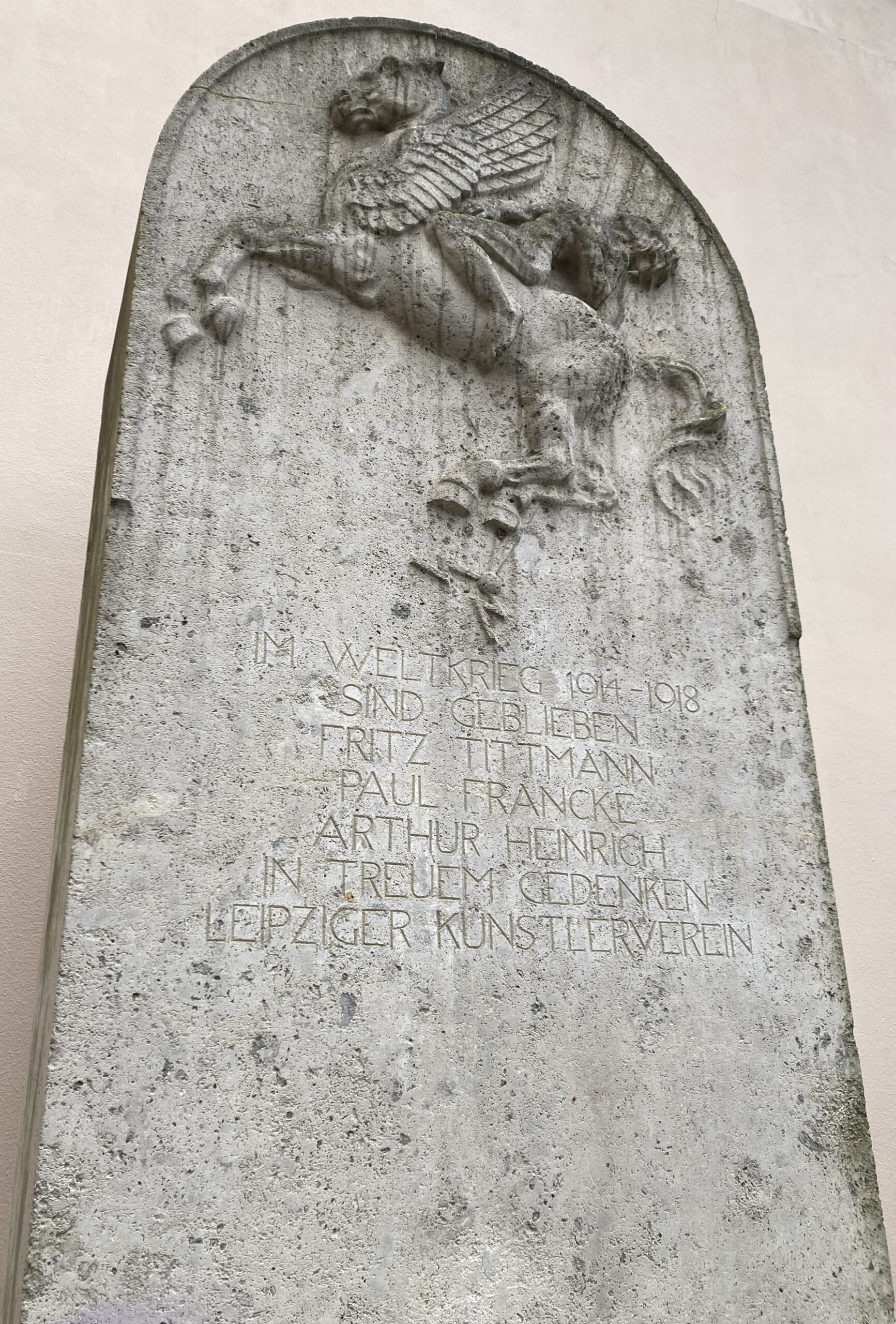
“Is that a memorial stone?” I ask.
We go in for a closer look. Mounted on a wall is a tablet with a carving of a dying man atop a Pegasus (who’s been struck by lightning) and a dedication to three artists claimed by the First World War.
“Did they live here?” I’m unsure. “These buildings look too modern. And what’s with these two pillars here? Looks like a gateway, but to nothing. It’s completely incongruous.”
“I agree. It’s really strange.”
We walk through and enter the plaza, which is a beguiling mix of Jugendstil buildings and more pebble-dash prefabs. There’s an oval island of snowy grass in the centre, around which runs a road. A tall wooden box stands at each end of the oval.
“What are those?” The Mathematician asks.
“My guess is that they’re statues. Look, there’s a little window in that one. I can see a face. I think they’ve boxed them up for the winter, like the statues in Agra Park in Markkleeberg.”
“I think you’re right. I wonder what they look like.”
“We can come back in spring and have a look.”
“We should. Okay, onwards. The theatre’s just up ahead down”— she looks around —“this road.”
It’s 100 metres away, about the same length as the queue of people that stretches around the block.
“Oh, no,” says The Mathematician. “They can’t all be queueing for the costume sale, can they? It’s freezing — who comes out on a day like this. Can we go and look? I want to look at the entrance, to check.”
We look, and yes, they are all waiting to get in.
“You think it’s already full inside?” I say. “The queue’s not even moving.”
“Aw … I really wanted to see what they had.”
The disappointment on her face is heartbreaking.
“Shall we join the line then?”
She shakes her head.
“I’m already freezing. I can’t feel my feet. Plus the air quality’s awful.”
“Would you like to go somewhere else? A café maybe, or the wool shop?”
“No, I just want to go home.”
I give her a kiss.
“Let’s have a nice hot cocoa when we get back.”
We consider which way would be best to take and decide on the route we just travelled. Serendipity. Back in Nikischplatz we see the other side of the gatehouse. The words Kuenstler Haus are written on the lintel and there are plaques on the pillars.
“Oh, wow,” I say, excitedly, “look at this!”
There’s a photograph of what once stood beyond the gate: a beautiful Jugendstil house that was a residence for artists, architects, and sculptors. It was built in 1900 to a design that more than 20 of the artists were involved with. It even had a restaurant, artist’s café, and bowling alley.
“You were right,” I say, pointing to a line of text. “A giant did pull this place apart. But it was a giant bomb.”
The place was destroyed on 4th December, 1943, in one of the biggest allied bombing runs on the city.
“That memorial stone we saw was once inside, installed in a public passage.”
“At least it survived.”
“Yeah, but look at what didn’t.”
I point mournfully at the picture. We continue on our way.
“On certain nights of the year, when the full moon shines on the gatehouse, it reappears,” I say. “You can enter, talk to all the artists there, drink coffee. But you must leave before dawn, else the house will vanish with you still inside, and you’ll have to wait until the next special night before returning.” I rub my eyes, which are starting to feel sandy. “This city’s a tale that writes itself. Oh, look at that!”
We’ve taken a route down a passage beside C’est La Vie, and on the side of a building ahead is a 2-storey black and white photo of what looks like the inside of a synagogue.
“Is that a picture of what used to be here?” I look around. There’s a small car park nearby and some garages. “Incredible! All the things we’re finding today. It’s like we’re explorers in a secret city.”
The Mathematician smiles at my joy.
“Well, where to next?” she says.
“Um, let’s just carry on along here and turn right — which is the way home — and see what we find. There’s a bridge!”
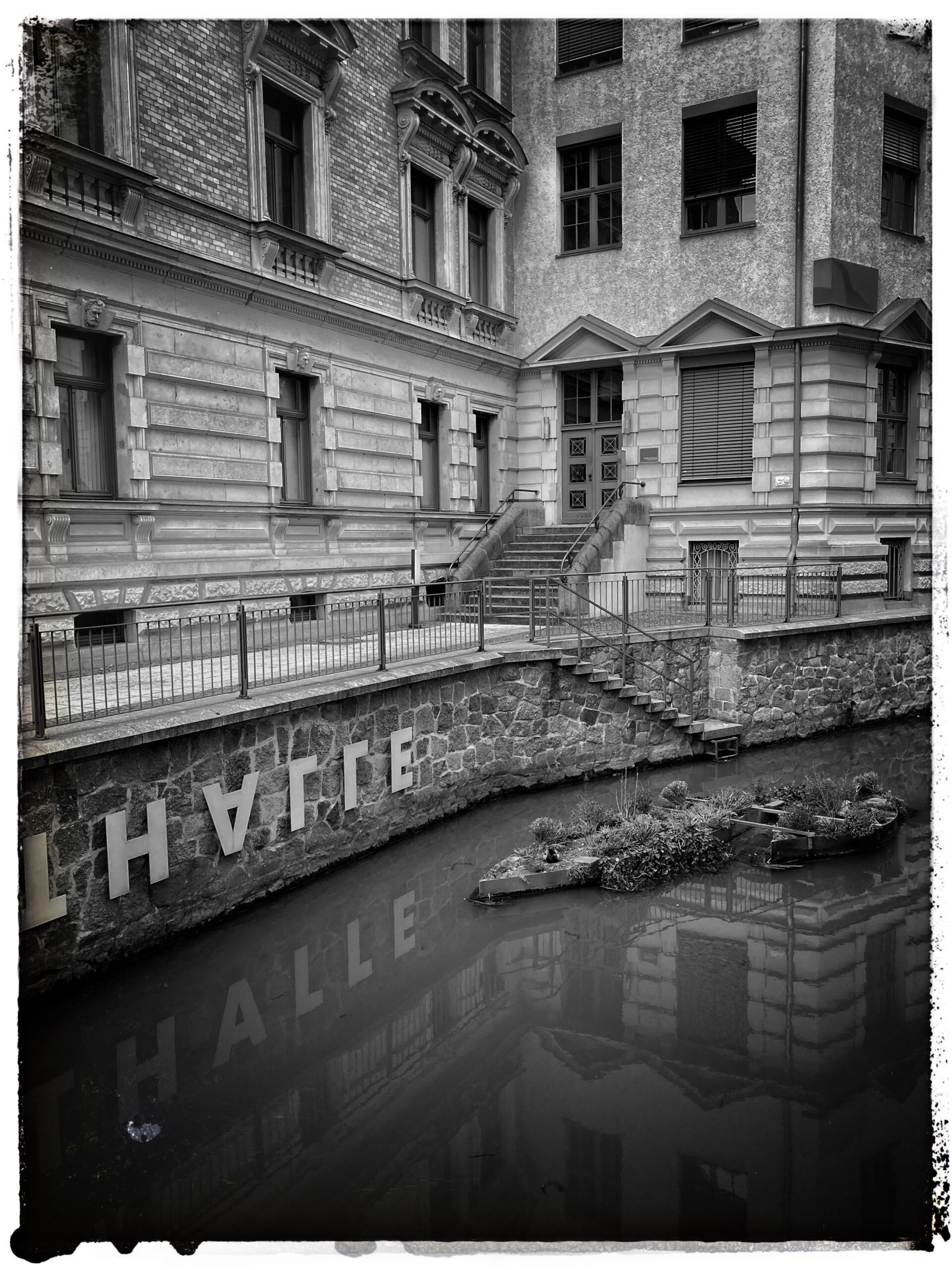
There is indeed a little bridge ahead, crossing the Pleißemühlgraben (the River Pleiße mill stream).
“Shall we follow the water home?” asks TM.
I nod, excited.
Along the way we find steps leading down to the water at various intervals (smuggler’s steps descended at night by coves bearning lanterns). We see a few small artificial islands with ducks and cormorants sheltering from the cold, heads tucked behind wings. We come to a bridge and watch the stream disappear into a tiny tunnel.
“Ooh,” I say. “I wonder what’s in there?”
“It carries on across the road,” says an elderly gentleman, passing us on the track. “We’ve just come from there.” His wife nods in agreement.
“Thanks for the tip,” I say. “Have a nice day.”
They wish us the same and leave. We continue on.
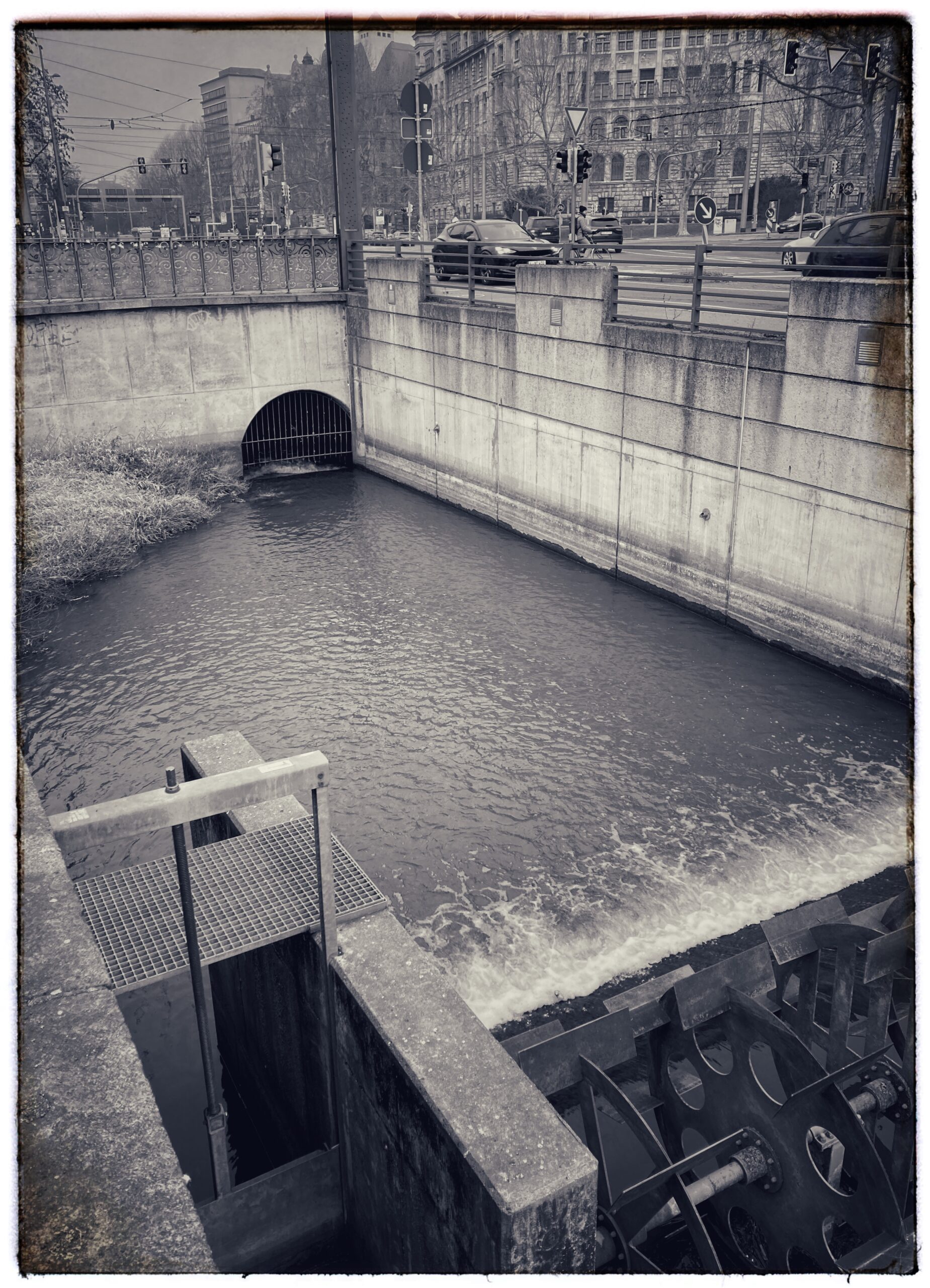
“An old hydraulic roller!”
We’re across the busy Karl-Tauchnitz and alongside Harkort. We’ve been here before, and seen this very piece of 19th century machinery, but not through the lens of waterborne discovery. There used to be a mill here (as you might expect, alongside a mill stream). There’s also a pair of ducks repeatedly dipping their beaks into the water, the drake more often than the hen.
“What are they doing?” I ask.
“Not sure. Some kind of courtship ritual?”
“At this time of year? Half the water’s frozen!”
It turns out that yes, at this time of year. The drake hops up onto the hen’s back, flaps its wings, half drowns her, takes her head in its beak, pushes it under the water, then hops off. A few seconds later, they’re paddling slowly upstream.
“Wow,” I say. “Didn’t expect that.”
“Me neither.”
An hour or so later we’re back home, having veered off to explore a coffee rosters housed in an old yellow brick building (with matching chimney). Our eyes and chest feel rough from dirty air.
“But I’m glad we saw all of it,” I say. “Such an adventure.”
“It was. But next time it’s like this, we’re going somewhere indoors. Somewhere we can breathe.”
“Agreed.”
Which brings me to Cyneburg’s Eve, the 31st of January, and the last post on the Mole for a while. As much as it saddens me to pause — not stop — writing here, there’s a young girl of the Gewisse whose story needs to reach a wider audience. You can find out more on my personal site, https://christophermollison.is. (Which is to say, find out soon, once I’ve finished building it.)
There’ll not be weekly posts there, but if you’re interested in Anglo-Saxon history, the craft of writing, or sneak-peeks of the novel, come on by. The hearth of Foxley’s great hall awaits.
—
(*) There are many of these spots across the city: designated areas to drag your once-beloved pine or spruce, to be picked up by city workers. They’re fragrant to walk past, but sad to look at.